



Friction Basics
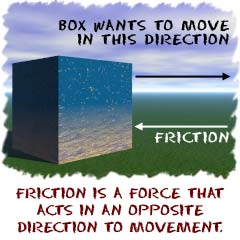 Friction is a force that holds back the movement of a sliding object. That's it. Friction is just that simple.
You will find friction everywhere that objects come into contact with each other. The force acts in the opposite direction to the way an object wants to slide. If a car needs to stop at a stop sign, it slows because of the friction between the brakes and the wheels. If you run down the sidewalk and stop quickly, you can stop because of the friction between your shoes and the cement.
What happens if you run down the sidewalk and you try to stop on a puddle? Friction is still there, but the liquid makes the surfaces smoother and the friction a lot less. Less friction means it is harder to stop. The low friction thing happens to cars when it rains. That's why there are often so many accidents. Even though the friction of the brakes is still there, the brakes may be wet, and the wheels are not in as much contact with the ground. Cars hydroplane when they go too fast on puddles of water.
Friction and Gases
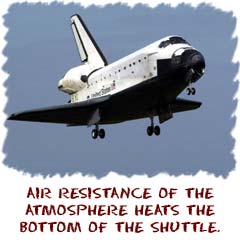 Friction only happens with solid objects, but you do get resistance to motion in both liquids and gases. This doesn't involve sliding surfaces like friction does, but is instead the kind of resistance you get if you try to push your way through a crowd. It's a colliding situation, not a sliding one. If the gas is air, this is referred to as air resistance.
If you were in the space shuttle and re-entering the atmosphere, the bottom of the shuttle would be getting very hot. The collisions that occur between the molecules of the air being compressed by the shuttle, heat up the air AND the shuttle itself. The temperature on the top of the shuttle is also warm, but nowhere near the temperatures found on the bottom.
Friction and Liquids
Although liquids offer resistance to objects moving through them, they also smooth surfaces and reduce friction. Liquids tend to get thinner (less viscous) as they are heated. Yes, that's like the viscosity of the oil you put in your car. Car engines have a lot of moving parts, and they rub on each other. The rubbing produces friction and the result is heat. When oil is added to a car engine, the oil sticks to surfaces, and helps to decrease the amount of friction and wear on the parts of the engine. An engine that runs hotter requires a more viscous oil in order for it to stick to the surfaces properly.Measuring Friction
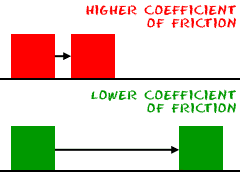 Measures of friction are based on the type of materials that are in contact. Concrete on concrete has a very high coefficient of friction. That coefficient is a measure of how easily one object moves in relationship to another. When you have a high coefficient of friction, you have a lot of friction between the materials. Concrete on concrete has a very high coefficient, and Teflon on most things has a very low coefficient. Teflon is used on surfaces where we don't want things to stick; such as pots and pans.
Scientists have discovered that there is even less friction in your joints than in Teflon! It is one more example at how efficient living organisms can be.


Or search the sites for a specific topic.
- Overview
- Forces
- Vectors
- Laws of Motion
- Energy of Motion
- Velocity
- Momentum
- Friction
- Gravity
- Work
- More Topics

Space Shuttle Thermal Protection (NASA-eClips Video)

Useful Reference Materials
Encyclopedia.com:http://www.encyclopedia.com/topic/friction.aspx
Wikipedia:
http://en.wikipedia.org/wiki/Friction
Encyclopædia Britannica:
http://www.britannica.com/EBchecked/topic/220047/friction
 Go for site help or a list of physics topics at the site map!
©copyright 1997-2015 Andrew Rader Studios, All rights reserved.
Current Page: Physics4Kids.com | Mechanics & Motion | Friction
** Andrew Rader Studios does not monitor or review the content available at external web sites. They are paid advertisements and neither partners nor recommended web sites. Specific links for books on Amazon.com are only suggested starting points for further research. Please browse, research options, and choose the appropriate materials for your needs.